So you have come this far…
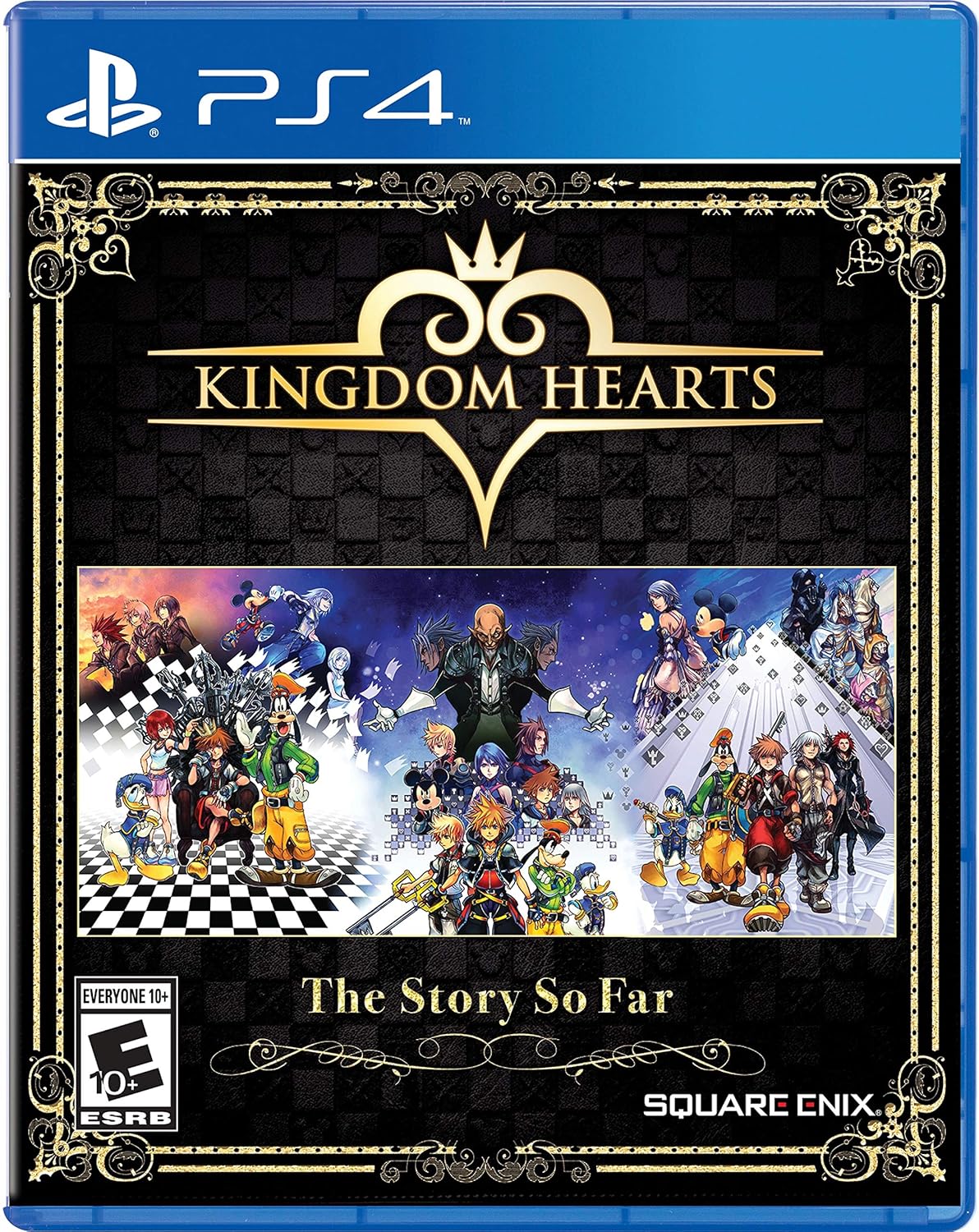
If you had asked me a few months ago what I thought of Kingdom Hearts, I’d have said “It’s alright. Haven’t played any games other than I and II, and I know I’m missing a lot. Kingdom Hearts III looks kinda cool. Maybe I should play the other games?” At least, that’s how I responded when I asked myself that very question. And then I grabbed the PS4 collections that I’d picked up a while back and started playing.
My initial plan was to play the series start to finish, getting as far as I could before Kingdom Hearts III arrived. Once III came out, I would switch to it, play to completion, and then go back to finish the rest of the story. I figured that there was a lot to get through, and didn’t expect to be able to finish.
I finished this week.
Going in, I wasn’t expecting a whole lot. I had some fond memories that I chalked up to nostalgia, but I was expecting some convoluted, opaque story as has often been alluded to. I also had some not so fond memories of the level design in Kingdom Hearts II, even if it had some fun combat mechanics.
Now on the other end of the journey, ready for Kingdom Hearts III, not only has my opinion of the series as a whole been raised substantially, I don’t even think it’s all that complicated.
…and still you understand nothing?
Kingdom Hearts is an Action Platformer Japanese RPG series, the first game being released in 2002 and with periodic releases on multiple platforms since. The series has come a long way from where it started, and seeing it in the full scope of that change in a highly condensed period of time clarified several things.
Thing #1: The narrative of Kingdom Hearts is no more complicated than Star Wars or your average shounen manga.
I want to go in to this in more detail, but to give you a taste of my thinking, Kingdom Hearts is a mythic fantasy, and is more focused on characterization and theme than it is on lore and plot. As it turns out, this is just about the only way to make a story like Kingdom Hearts function. The stuff that people call confusing all fall under the realm of lore and plot, stripping ideas of their context.
Stories are not written this way, and they are not intended to be read this way.
Thing #2: Writer, Director, and Storywriter Tetsuya Nomura cares more about Kingdom Hearts than he does about Final Fantasy.
Tetsuya Nomura is no stranger to Final Fantasy. He’s been working on it in various roles since Final Fantasy IV. He designed monsters in Final Fantasy V, my favorite SNES Final Fantasy. He was graphic director on Final Fantasy VI, and came up with the ideas for Shadow and Setzer. He designed characters for VII, VIII, X, XIII and XV.
And yet in none of those works do I detect as much love for the game than I do in his baby, Kingdom Hearts. I’m not even sure he gets the characters he designed for Final Fantasy the way he gets every little detail of Kingdom Hearts, as evidenced by his treatment of Cloud in both Final Fantasy VII: Advent Children and in Kingdom Hearts itself.
Tetsuya Nomura’s vision of Final Fantasy has never clicked with me. Even at its brightest and cheeriest, in Final Fantasy X, it doesn’t fit with my image of Final Fantasy, the one shaped by the SNES Final Fantasy’s and Final Fantasy IX. And after playing all of Kingdom Hearts, I think the big reason for that is crystal clear: unlike Final Fantasy, Kingdom Hearts is strictly his vision. He’s not answering anyone’s expectations but his own, so long as Disney signs off on it, and he’s having the time of his life with it.
Speaking of Disney…
Thing #3: The Disney worlds serve a narrative that is useful and necessary (when they’re done well).
A core premise I want to stress regarding JRPGs is that they exist at an intersection of narrative and play, with each reinforcing the other. JRPG level design follows a very typical narrative structure, the Quest. Not to be confused with Quests and Sidequests as Game Goals, here I specifically refer to a narrative structure in which a character has a goal and must face challenges to achieve it. The JRPG “Quest” structure typically (but not always) begins in a town and features a goal situated at the end of a dungeon, with battles throughout and a (hopefully) more challenging boss at the end. In a good JRPG, these will also double as a narrative exploring either a character or the game’s themes, sort of like how an episode of a television show would.
Kingdom Hearts shortcuts past the need for towns, but the Worlds in Kingdom Hearts serve much the same purpose. In my view, the best worlds are ones that don’t simply try to recreate the story of the Disney property it is adapting, but rather uses that property to comment on the overarching theme of the story. At its best, visiting Disney worlds in Kingdom Hearts feels like a useful way to deliver key emotional beats to help drive home the overall story.
(And at its worst, the worlds are simple retreads of property stories with a random OC insert.)
Thing #4: These games are actually really well designed. Like REALLY well designed. Even the ‘bad’ ones.
I should preface this by saying that as I played off the collections, I have no idea how 358/2 Days and re:coded play.
But apart from that, Kingdom Hearts is a series that shifts between focusing on a core feel in the console iterations (I, II and 0.2 BBS) and experimenting with offbeat ideas in the handheld iterations (CoM, BBS, DDD). In the former, they are hyperfocused on that core feel, and each one builds on the last, correcting problems and pulling in ideas from the handheld games where appropriate. In the latter, the spirit of experimentation sometimes gets in the way of being focused, but they create a feel and game language that work extremely well together. While there were times where I found myself being a bit frustrated by problems in all of these games, the solution was never “grind a lot more”, but instead “come back with a better strategy.”
What’s more, most of these games have a “Zero EXP” option included in the ability sets of the characters on the highest difficulty levels. This is a rather remarkable admission from the game designers of intent, and reflects a game design trend that I’ve not personally indulged in but has intrigued me from time to time: the notion that JRPGs can be beaten with having enough knowledge of how the game systems work that leveling up becomes unnecessary. In short, levels and grinding are a crutch. You don’t need them.
Thing #5: These games are perfect ways to kick off talking about JRPGs.
As I’ve said before, JRPGs are my favorite genre of video game. And while even after coming this far I don’t know if I’d rank Kingdom Hearts as one of my favorite JRPG series, it did have an impact on me in ways only JRPGs really can. Binging through it proved to be a time capsule of all the things I like about JRPGs, particularly PS2 era JRPGs, and if 0.2 is any indication that spirit is actually going to be carried forward.
So I want to start off this blog by walking through these games, one by one, both as a general experience and to talk about one facet of them that I think is particularly important in JRPG game and narrative design. My plan is to write a (hopefully not too long) essay on each one, leading up to my general impressions of Kingdom Hearts III, which I’ll probably have played through by the time these essays are finished.
These are the design themes I hope to discuss with each title:
Kingdom Hearts I – Concept
Kingdom Hearts re:Chain of Memories – Experimentation
Kingdom Hearts II – Play
Kingdom Hearts Birth By Sleep – Characters
Kingdom Hearts Dream Drop Distance – Refinement
Kingdom Hearts 358/2 Days, re:coded and χ Back Cover – Cutscenes & Narrative
I’m not really going to talk about Kingdom Hearts 0.2 Birth By Sleep: A Fragmentary Passage in its own essay, but I will make reference to it in my essays on Kingdom Hearts II, Kingdom Hearts Birth By Sleep, and Kingdom Hearts Dream Drop Distance, since my thoughts on it dovetail nicely with those games.
Surely this can’t be any sillier of an idea than binging all of Kingdom Hearts in a month to prepare for a new title.
May your heart be your guiding key.
❤ Touhi

 Touhi Touko's Blog